Blog

  • What New U.S. Crypto Trading Rules Could Mean for Traders?

    What New U.S. Crypto Trading Rules Could Mean for Traders?

    The cryptocurrency market continues to evolve, and regulation remains one of the biggest factors shaping its future.

    On October 5, 2026, the U.S. Commodity Futures Trading Commission (CFTC) proposed new rules aimed at creating a federal framework for certain crypto trading platforms. The proposal focuses particularly on exchanges offering leveraged, financed, or margined crypto trading. Reuters

    For crypto traders, this raises an important question:

    What could clearer regulation mean for the way crypto trading works?

    Let’s break it down.

    What did the CFTC propose?

    The CFTC proposed a framework under which certain crypto trading platforms could register for federal oversight.

    The proposed rules would establish a new category called “crypto asset markets.” Platforms covered by the framework would face requirements designed to strengthen market integrity and customer protections.

    These could include:

    • Anti-manipulation controls
    • Proof-of-reserves requirements
    • Federal oversight for certain trading activities
    • Additional requirements for intermediaries handling customer trades

    However, the proposal is not the same as a final regulation. It would still need to go through the regulatory process, and its implementation could depend on future legal and political developments. Reuters

    Why is this important for crypto traders?

    For years, crypto regulation in the U.S. has involved a mixture of federal and state-level rules.

    The new CFTC proposal is significant because it could create a clearer federal framework for some types of crypto trading.

    For traders, clearer rules could potentially make it easier to understand:

    • Which platforms fall under federal oversight
    • What requirements trading platforms must meet
    • How leveraged crypto trading is supervised
    • What protections and obligations apply to different market participants

    However, regulation does not automatically remove market risk.

    Crypto prices can still move sharply because of market sentiment, liquidity, macroeconomic conditions, leverage, and other factors.

    What about spot crypto trading?

    This is an important distinction.

    The latest CFTC proposal focuses on platforms offering leveraged, financed, or margined transactions. It does not, by itself, establish comprehensive federal regulation for ordinary spot crypto trading. The Wall Street Journal

    That means traders should not interpret the proposal as a complete regulatory framework for every type of cryptocurrency transaction in the U.S.

    The broader regulatory picture remains a work in progress.

    Could regulation improve market transparency?

    One of the notable elements of the proposal is the potential use of proof-of-reserves requirements for covered platforms.

    Proof of reserves is designed to provide information about whether a platform holds sufficient assets to support customer obligations.

    However, proof of reserves should not be viewed as a complete measure of an exchange’s overall financial health or security.

    It is one part of a broader transparency framework.

    Other factors can also matter, including governance, custody practices, security controls, liquidity, risk management, and regulatory compliance.

    What does this mean for leveraged trading?

    Leverage allows traders to control a larger position using less capital.

    However, it also increases risk.

    A relatively small market movement can create a much larger gain or loss on a leveraged position. In some situations, sharp price movements can trigger liquidations and add further buying or selling pressure to the market.

    The proposed CFTC framework could bring greater federal oversight to platforms offering this type of trading. Reuters

    For traders, this is a reminder that understanding how leverage works is just as important as understanding the asset being traded.

    Does regulation mean crypto is becoming less decentralized?

    Not necessarily.

    Regulation and decentralization address different parts of the crypto ecosystem.

    Blockchain networks can continue operating through decentralized protocols, while companies that provide trading, custody, or financial services may be subject to regulatory requirements.

    In other words, regulation generally targets activities and service providers, rather than changing the fundamental technology behind blockchain networks.

    What should crypto traders watch next?

    The proposed rules are only one part of a larger regulatory discussion.

    Traders should watch for:

    1. Further CFTC developments

    The proposal could change as regulators receive feedback and work through the rulemaking process.

    2. Congressional action

    Broader U.S. crypto legislation could influence how federal agencies divide responsibilities over digital assets.

    3. SEC developments

    The SEC is also working on crypto-related rules, including developments around tokenized assets and custody. The Wall Street Journal

    4. Exchange compliance

    As regulatory frameworks develop, trading platforms may need to adjust their compliance, reporting, risk-management, and operational practices.

    What does this mean for everyday crypto users?

    For everyday users, the biggest takeaway is simple:

    Crypto regulation is becoming an increasingly important part of the market.

    Regulatory developments can affect exchanges, traders, institutions, token issuers, and other participants differently.

    But regulation does not replace the need for responsible trading.

    Before trading crypto, users should understand the asset, the platform they are using, the fees involved, and the risks associated with volatility and leverage.

    Final Thoughts

    The CFTC’s latest proposal represents another step in the ongoing effort to establish clearer rules for parts of the U.S. crypto trading market.

    For traders, the potential benefits of clearer oversight include greater transparency and more defined regulatory responsibilities. At the same time, the proposal is still part of a developing process, and the final framework may change.

    As crypto markets mature, understanding regulation will become just as important as understanding price charts.


  • What Causes Crypto Market Volatility?

    What Causes Crypto Market Volatility?

    If you follow crypto, you have probably noticed how quickly prices can change.

    Bitcoin, Ethereum, and other cryptocurrencies can move sharply within a short period. Sometimes prices rise quickly. At other times, the market can fall just as fast.

    This is known as crypto market volatility.

    But why does crypto move so much?

    What Is Crypto Volatility?

    Volatility refers to how much and how quickly an asset’s price changes over a period of time.

    A highly volatile asset can experience large price movements in a short time. Crypto is generally considered a volatile market because prices can react quickly to changes in buying and selling activity, sentiment, liquidity, and new information.

    Volatility does not automatically mean prices will go up or down. It simply means larger price movements can happen more frequently.

    Why Is Crypto So Volatile?

    1. Market Sentiment

    Investor sentiment can have a strong effect on crypto prices.

    When investors feel optimistic, buying activity can increase. When fear or uncertainty spreads, investors may reduce their exposure.

    This can create rapid movements across the market.

    For example:

    Positive sentiment → More buying → Potential upward pressure

    Negative sentiment → More selling → Potential downward pressure

    However, sentiment alone does not determine prices.

    2. Supply and Demand

    Like other markets, crypto prices are influenced by supply and demand.

    When demand increases while available supply is limited, prices may rise. When selling pressure becomes stronger than buying demand, prices may fall.

    Because crypto markets operate continuously, changes in demand can happen at any time.

    3. Liquidity

    Liquidity refers to how easily an asset can be bought or sold without causing a significant change in its price.

    Large, highly liquid cryptocurrencies can generally handle bigger trades more easily than smaller, less liquid assets.

    When liquidity is lower, even relatively smaller orders can have a larger effect on price.

    This is one reason some altcoins can experience much larger percentage movements than major cryptocurrencies.

    4. News and Market Events

    Crypto investors closely watch developments that could affect the market.

    These may include:

    • Regulatory announcements
    • Economic developments
    • Security incidents
    • Major industry news
    • Network upgrades
    • Exchange-related developments

    When important information reaches the market, investors may react quickly.

    That reaction can increase buying or selling pressure and lead to higher volatility.

    5. Leverage and Liquidations

    Crypto trading also includes derivatives and leveraged positions.

    Leverage allows traders to control a larger position with a smaller amount of capital. However, it also increases risk.

    If prices move sharply against leveraged positions, those positions may be liquidated.

    Large-scale liquidations can add further buying or selling pressure and sometimes make an existing market move more intense.

    Why Can Altcoins Be More Volatile?

    Not all cryptocurrencies have the same level of volatility.

    Smaller cryptocurrencies often have lower liquidity and smaller market sizes than major assets such as Bitcoin.

    As a result, changes in buying or selling activity can sometimes cause larger percentage price movements.

    Project-specific developments can also affect an individual altcoin more strongly.

    That is why two cryptocurrencies can react very differently to the same market conditions.

    Does High Volatility Mean the Market Is Going Down?

    No.

    Volatility works in both directions.

    A highly volatile market can experience sharp increases as well as sharp declines.

    For example:

    Low volatility:
    Price moves gradually over time.

    High volatility:
    Price can move significantly in either direction within a shorter period.

    Therefore, volatility should not automatically be confused with a bearish market.

    Why Should Crypto Investors Understand Volatility?

    Understanding volatility can help investors interpret price movements more realistically.

    A sudden price change does not always mean that something fundamental has changed with a cryptocurrency. Sometimes it can be the result of broader market sentiment, liquidity, leverage, or new information.

    At the same time, large price movements can increase risk.

    This is why understanding the factors behind volatility is important before making trading or investment decisions.

    Final Thoughts

    Crypto market volatility comes from several factors working together.

    Market sentiment, supply and demand, liquidity, news, leverage, and investor behavior can all contribute to rapid price movements.

    Volatility is a natural part of cryptocurrency markets, but it does not guarantee a particular direction.

    Instead of asking only “Why did the price move?”, it can be useful to ask:

    “What changed in the market that caused investors to buy or sell?”

    Understanding that difference can help you look at crypto price movements with a clearer perspective.

  • Why Do Crypto Prices Move Together?

    Why Do Crypto Prices Move Together?

    Have you ever noticed Bitcoin falling while Ethereum and many altcoins also start falling?

    The same thing can happen when the market rises. Bitcoin moves up, and other cryptocurrencies may follow.

    This is not a coincidence. Several factors connect different cryptocurrencies and can cause their prices to move in similar directions.

    What Is Crypto Market Correlation?

    Crypto market correlation describes how the prices of different cryptocurrencies move in relation to each other.

    When two assets often move in the same direction, they have a positive correlation. When they frequently move in opposite directions, they have a negative correlation.

    In crypto, many assets can show positive correlation, particularly during periods of strong market-wide sentiment.

    However, cryptocurrencies do not always move together.

    Why Does Bitcoin Matter?

    Bitcoin is the largest and most widely followed cryptocurrency by market value. Because of its important position in the crypto market, significant Bitcoin price movements can influence overall market sentiment.

    For example, when Bitcoin falls sharply, investors may become more cautious about other cryptocurrencies as well. This can create selling pressure across different parts of the market.

    The opposite can happen during periods of positive sentiment.

    However, Bitcoin does not directly determine the price of every cryptocurrency. Each asset can also respond to its own market conditions and developments.

    Market Sentiment Plays a Big Role

    Investor sentiment is one of the biggest reasons crypto prices can move together.

    When investors feel confident, they may be more willing to take risks and buy cryptocurrencies.

    When fear or uncertainty increases, investors may reduce their exposure to riskier assets.

    This can create broad market movements.

    For example:

    Positive sentiment → More buying → Prices may rise across several crypto assets

    Negative sentiment → More selling → Prices may fall across several crypto assets

    This is also why market-wide events can affect many cryptocurrencies at the same time.

    Why Do Altcoins Often Move More?

    Altcoins can sometimes experience larger percentage price movements than Bitcoin.

    One reason is that many altcoins have smaller market sizes and lower liquidity than Bitcoin. When significant buying or selling takes place, their prices can react more strongly.

    For example, a market decline that causes a moderate move in Bitcoin could result in a larger percentage decline in some smaller cryptocurrencies.

    However, this varies from one asset to another.

    Do All Crypto Prices Move Together?

    No.

    Cryptocurrencies can behave differently because each project has its own factors.

    These can include:

    • Project developments
    • Token supply changes
    • Network upgrades
    • Exchange listings
    • Partnerships
    • Regulatory developments
    • Trading activity
    • Project-specific news

    For example, one cryptocurrency may rise because of positive news about its project even when the broader market is falling.

    So, while market-wide trends can influence many assets, individual factors still matter.

    Why Does Crypto Market Correlation Matter?

    Understanding crypto market correlation can help investors better interpret market movements.

    If several cryptocurrencies fall at the same time, it does not necessarily mean that something went wrong with every individual project.

    The movement may be connected to broader factors such as market sentiment, liquidity, or Bitcoin’s movement.

    At the same time, investors should not assume that every cryptocurrency will always follow Bitcoin.

    Final Thoughts

    Crypto prices often move together because cryptocurrencies operate within a connected market.

    Bitcoin’s market influence, investor sentiment, liquidity, and broader market conditions can all contribute to similar price movements.

    However, correlation can change over time, and individual cryptocurrencies can move differently because of their own developments.

    Understanding this relationship can give you a clearer picture of why the crypto market sometimes moves as one—and why it sometimes doesn’t.

  • Flight to Safety in Crypto

    Flight to Safety in Crypto

    Crypto markets can move quickly. When uncertainty increases, investors may start becoming more cautious about risk.

    Some may reduce their exposure to highly volatile cryptocurrencies and move their funds toward assets they consider relatively more stable or liquid.

    This behavior is known as a flight to safety in crypto.

    But what does it mean in crypto, and where can investors move their money?

    What is a Flight to Safety in Crypto?

    A flight to safety happens when investors become more cautious during periods of uncertainty.

    Instead of taking the same level of risk, they may move money away from assets they consider riskier and toward assets they perceive as offering greater stability or liquidity.

    In crypto, this movement can take different forms:

    Altcoins → Bitcoin

    Volatile crypto assets → Stablecoins

    Crypto → Fiat currency

    The important point is that a flight to safety in crypto does not mean every investor sells. It describes a shift in behavior among some market participants who want to reduce their perceived risk.

    Why does it happen in Crypto?

    Cryptocurrency markets can experience significant volatility, so changes in market sentiment can affect investor behavior quickly.

    A flight to safety may occur during periods of uncertainty caused by factors such as:

    • Sharp market declines
    • Regulatory developments
    • Security incidents
    • Economic uncertainty
    • High market volatility
    • Changes in investor sentiment

    When uncertainty rises, some investors may choose to reduce their exposure to higher-risk assets rather than continue taking the same level of risk.

    Where can Investors move their money?

    There is no single destination during a flight to safety. The choice depends on the investor, their risk tolerance, and the market environment.

    Bitcoin

    Some investors may move funds from smaller or more volatile cryptocurrencies into Bitcoin.

    Bitcoin is a major cryptocurrency with substantial market liquidity, but it remains a volatile asset. Therefore, moving from an altcoin into Bitcoin should not automatically be considered a move into a “safe” asset.

    Instead, it may represent a decision to reduce exposure to some of the risks associated with smaller or less liquid cryptocurrencies.

    Stablecoins

    Stablecoins can also be part of this shift.

    For example, a trader holding an altcoin may sell it and hold USDT instead. This can reduce exposure to cryptocurrency price movements while allowing the trader to keep funds within the crypto ecosystem.

    However, stablecoins are not risk-free. Their stability can depend on factors such as their design, reserves, liquidity, issuer, and regulatory environment.

    Therefore, holding a stablecoin is not the same as holding cash in a bank account.

    Fiat Currency

    Some investors may choose to leave the crypto market altogether and convert their holdings into fiat currency, such as INR or USD.

    This represents a broader reduction in exposure to cryptocurrency price movements.

    Is bitcoin a safe-haven asset?

    This question does not have a simple answer.

    Bitcoin is sometimes discussed as a potential alternative asset or hedge against certain risks. However, Bitcoin can experience large price movements and remains a volatile asset.

    During some periods of market stress, Bitcoin can fall alongside other risk assets. In other situations, investors may move from smaller cryptocurrencies into Bitcoin.

    So, it is more accurate to describe Bitcoin based on its market characteristics and risks rather than simply calling it a “safe-haven” asset.

    Flight to Safety vs. Flight from Crypto

    These two terms are related, but they describe different types of behavior.

    A flight to safety within crypto means an investor reduces exposure to more volatile crypto assets but continues to hold an asset within the crypto ecosystem.

    For example:

    Altcoin → USDT

    A flight from crypto means an investor reduces their overall exposure to the cryptocurrency market.

    For example:

    Bitcoin → INR or USD

    This distinction matters because money leaving one cryptocurrency does not necessarily mean it has left the entire crypto market.

    Does a flight to safety in crypto mean crypto prices will fall?

    Not necessarily.

    A flight to safety in crypto can contribute to selling pressure in some cryptocurrencies, particularly assets that investors perceive as carrying higher risk. However, cryptocurrency prices are influenced by many factors, including supply and demand, liquidity, market sentiment, economic conditions, and new information.

    Capital can also move from one crypto asset to another instead of leaving the market completely.

    For this reason, a risk-off period should not automatically be interpreted as a complete exit from crypto.

    Why does this matter?

    Understanding flight-to-safety behavior can help explain what is happening beneath the surface of the crypto market.

    Instead of looking only at whether prices are rising or falling, investors can also consider where capital may be moving.

    For example, movement from more volatile cryptocurrencies toward stablecoins may indicate that some market participants are trying to reduce exposure to crypto price volatility.

    Similarly, movement from smaller cryptocurrencies into Bitcoin may indicate a preference for a more established and liquid cryptocurrency within the market.

    These movements can provide useful context when assessing changes in market sentiment, although they do not guarantee what prices will do next.

    Final Thoughts

    A flight to safety is a shift in investor behavior that can occur when uncertainty increases and some investors want to reduce their perceived risk.

    In crypto, this can involve moving from more volatile assets toward Bitcoin, stablecoins, or fiat currency.

    However, “safer” does not mean “risk-free.” Bitcoin remains volatile, stablecoins have their own risks, and market conditions can change quickly.

    Understanding where investors may be moving their capital can provide useful context for interpreting crypto-market behavior.

    The key question is not simply “Are crypto prices going up or down?”

    It is also:

    “How are investors responding to changing levels of risk?”

    Trade on the Go with the Cofinex Mobile App

    Download for Android

    Download for iOS

    Follow Cofinex

    Telegram: https://t.me/cofinexofficial

    X (Twitter): https://x.com/CofinexExchange

    Facebook: https://www.facebook.com/

    Instagram: https://www.instagram.com/cofinexexchange/

    LinkedIn: https://in.linkedin.com/company/cofinexexchange

    WhatsApp Channel: https://whatsapp.com/channel/0029VbBSQtJ2P59lfbaRXJ2k

    YouTube: https://www.youtube.com/@cofinexexchange

  • Bitcoin vs. Gold: Which Investment makes more sense in market?

    Bitcoin vs. Gold: Which Investment makes more sense in market?

    When markets become uncertain, one question often comes up: Should you invest in Bitcoin or Gold? Gold has protected wealth for centuries, while Bitcoin has emerged as one of the world’s leading digital assets. Both are popular investment choices, but they offer different benefits, risks, and opportunities.

    Today, inflation concerns, changing interest rate expectations, and global economic uncertainty continue to influence financial markets. As a result, both Bitcoin and gold remain in the spotlight. Gold is widely known as a safe-haven asset during uncertain times. Bitcoin, meanwhile, attracts investors looking for long-term growth and exposure to the digital economy.

    So, which investment is the better choice? The answer depends on your financial goals, risk tolerance, and investment horizon. Let’s compare both assets and understand how they fit into today’s market.

    Gold: A Time-Tested Safe Haven

    Gold has been used as a store of value for thousands of years. It has consistently helped investors preserve wealth during periods of inflation, economic slowdowns, and geopolitical uncertainty.

    Even today, gold remains a preferred defensive asset. When financial markets become volatile, many investors increase their exposure to gold because of its long history of stability. Although short-term price movements are common, gold continues to play an important role in diversified portfolios.

    Bitcoin: The Digital Alternative

    Bitcoin was introduced in 2009 as the world’s first decentralized cryptocurrency. Unlike traditional currencies, Bitcoin has a fixed supply of 21 million coins. This limited supply is one of the main reasons many investors consider Bitcoin a scarce digital asset.

    Although Bitcoin is known for its price volatility, it continues to attract both retail and institutional investors. In addition, its global accessibility and growing adoption have strengthened its position in the digital asset market.

    Many investors view Bitcoin as a long-term investment rather than a short-term trading opportunity.

    Why Do Investors Compare Bitcoin and Gold?

    Bitcoin and gold are often compared because both are viewed as stores of value. However, they achieve this in different ways.

    Gold has a long history of preserving purchasing power and generally experiences lower price volatility. Bitcoin, on the other hand, offers higher growth potential but comes with greater market risk.

    Instead of choosing one over the other, many investors include both assets in their portfolios to balance stability with long-term growth.

    Bitcoin vs. Gold: Key Differences

    FeatureBitcoinGold
    SupplyFixed at 21 million BTCSupply increases through mining
    AvailabilityDigital and available 24/7Physical and digital investment options
    VolatilityHigherLower
    AccessibilityGlobal trading anytimeAvailable through physical and financial markets
    Primary UseDigital asset and store of valueSafe-haven asset and wealth preservation

    Which Investment Is Better?

    There is no single answer because every investor has different financial goals.

    If your priority is preserving wealth and reducing risk, gold may be the better option. Its long history and relatively lower volatility make it a trusted investment during uncertain market conditions.

    However, if you have a higher risk tolerance and a longer investment horizon, Bitcoin may offer greater growth potential. Investors should remember that Bitcoin can experience significant price swings over short periods.

    For many investors, diversification is the most balanced approach. Holding both Bitcoin and gold can provide exposure to growth while helping reduce overall portfolio risk.

    Final Thoughts

    Bitcoin and gold are not competitors. Instead, they serve different purposes in a well-balanced investment portfolio.

    Gold continues to offer stability during uncertain economic conditions. Meanwhile, Bitcoin represents innovation and long-term growth potential in the digital asset market.

    Rather than asking which asset is better, consider how each one aligns with your financial goals, investment timeline, and risk tolerance. A diversified approach may help you build a stronger and more balanced portfolio over time.

    Frequently Asked Questions

    Is Bitcoin replacing gold?

    No. Bitcoin is often called “digital gold,” but it has not replaced gold. Both assets serve different purposes and can complement each other in an investment portfolio.

    Why is gold considered a safe-haven asset?

    Gold has historically maintained its value during inflation, economic uncertainty, and geopolitical tensions. For this reason, many investors use it to preserve wealth.

    Why is Bitcoin more volatile than gold?

    Bitcoin is a younger asset class. Therefore, its price reacts more quickly to changes in investor sentiment, market demand, liquidity, and regulations.

    Should I invest in Bitcoin or gold?

    The right choice depends on your financial goals and risk tolerance. Some investors prefer gold for stability, while others choose Bitcoin for long-term growth. Many invest in both.

    Can Bitcoin and gold be part of the same portfolio?

    Yes. Holding both assets can improve diversification by combining Bitcoin’s growth potential with gold’s long-standing reputation as a defensive investment.

    Disclaimer: This article is for educational and informational purposes only. It should not be considered financial, legal, or investment advice. Cryptocurrency and commodity investments involve risk. Always conduct your own research before making investment decisions.

  • Does Bitcoin Halving Affect Bitcoin Price?

    Does Bitcoin Halving Affect Bitcoin Price?

    Bitcoin halving is one of the biggest events in the cryptocurrency market. Every four years, the Bitcoin network automatically reduces the reward miners receive for validating transactions. This event slows the rate at which new Bitcoins enter circulation and often attracts significant attention from traders and investors.

    But does Bitcoin halving actually affect Bitcoin’s price?

    The short answer is yes—but not by itself.

    What Is Bitcoin Halving?

    Bitcoin halving is a built-in feature of the Bitcoin blockchain. It occurs approximately every four years, or after every 210,000 blocks are mined.

    During a halving, the mining reward is reduced by 50%. Today, miners earn fewer new Bitcoins for securing the network than they did in previous years.

    This mechanism helps keep Bitcoin’s total supply limited to 21 million coins, making it one of the few digital assets with a fixed maximum supply.

    Why Can Halving Influence Bitcoin’s Price?

    Halving reduces the number of new Bitcoins entering the market each day. If demand remains steady or increases while new supply slows, the market may experience upward price pressure over time.

    However, Bitcoin’s price is never determined by halving alone.

    Investor confidence, market demand, global economic conditions, regulations, and institutional participation all play an important role in shaping Bitcoin’s value.

    What Has History Shown?

    Previous Bitcoin halving events have been followed by periods of strong market growth. However, these price increases did not happen immediately after the halving.

    Instead, Bitcoin experienced gradual price appreciation over the months that followed. While many investors view halving as a bullish event, historical trends should not be considered a guarantee of future performance.

    Other Factors That Move Bitcoin’s Price

    Several factors influence Bitcoin’s market value every day, including:

    • Supply and demand
    • Institutional investment
    • Global economic conditions
    • Government regulations
    • Market sentiment
    • Blockchain adoption

    These factors often have just as much impact on Bitcoin’s price as the halving event itself.

    Should Investors Expect an Immediate Price Rally?

    Not necessarily.

    Many people believe Bitcoin’s price will rise immediately after a halving, but markets rarely move in a straight line. Price movements depend on how investors react, overall market conditions, and global economic developments.

    For this reason, halving should be viewed as one piece of the bigger picture rather than the only driver of Bitcoin’s price.

    Final Thoughts

    Bitcoin halving is one of the most important events in the cryptocurrency ecosystem because it reduces the creation of new coins and reinforces Bitcoin’s scarcity.

    While previous halvings have often been followed by long-term price growth, there is no guarantee that history will repeat itself. Investors should always consider market conditions, conduct independent research, and understand the risks before making investment decisions.

    Frequently Asked Questions

    Does Bitcoin always increase after a halving?
    No. Previous halvings have been followed by price growth over time, but future market performance cannot be predicted.

    How often does Bitcoin halving occur?
    Bitcoin halving takes place approximately every four years, or after every 210,000 blocks are mined.

    Why is Bitcoin halving important?
    It slows the creation of new Bitcoins, helping maintain the cryptocurrency’s limited supply and long-term scarcity.

    Will Bitcoin stop being mined?
    No. Mining will continue until all 21 million Bitcoins have been created, which is expected around the year 2140. After that, miners are expected to earn transaction fees instead of block rewards.

    Disclaimer: This article is for informational purposes only and should not be considered financial or investment advice. Cryptocurrency investments involve risk. Always conduct your own research before making financial decisions.

  • Why Are Stablecoin Premiums Rising in India?

    India’s crypto market is witnessing an unusual rise in stablecoin premiums after recent enforcement actions against alleged illegal cross-border payment networks. The development has temporarily reduced the availability of stablecoins in the domestic market, leading to higher prices for assets such as USDT.

    What Happened?

    Recent action by the Enforcement Directorate (ED) targeted suspected unauthorized remittance networks that allegedly used stablecoins to facilitate cross-border transactions outside regulated banking channels.

    Following these actions, the supply of stablecoins in the local market tightened, creating a temporary imbalance between demand and available liquidity.

    Why Is USDT Trading at a Premium?

    A stablecoin premium occurs when a stablecoin trades above its intended value due to strong demand or limited supply.

    In the current market, USDT has been trading at a notable premium in India as traders compete for reduced liquidity. While global prices remain close to their intended value, local market conditions have resulted in higher domestic prices.

    What Does This Mean for Traders?

    The increase in stablecoin premiums may have several short-term effects:

    • Higher costs when purchasing USDT or other stablecoins.
    • Increased trading costs for investors entering crypto markets.
    • Lower profit margins for traders actively buying and selling digital assets.
    • Greater importance of comparing prices and liquidity across exchanges before trading.

    What Could Happen Next?

    Market participants are closely watching upcoming regulatory discussions surrounding virtual digital assets in India. Any policy updates or improvements in market liquidity could influence stablecoin premiums in the coming weeks.

    As supply conditions stabilize, premiums may gradually return to more typical levels, although future movements will depend on both market demand and the regulatory environment.

    Final Thoughts

    The recent increase in stablecoin premiums highlights how regulatory actions and liquidity conditions can directly influence crypto markets. While the premium reflects short-term market dynamics rather than changes in the value of the stablecoin itself, it serves as a reminder of the importance of staying informed about both market developments and regulatory changes.

    For traders and investors, understanding these factors can help support more informed decision-making during periods of market volatility.

    Disclaimer: This article is intended for educational and informational purposes only and should not be considered financial, legal, or investment advice.

  • How Cofinex helps beginners start crypto trading safely

    Starting your Cofinex crypto trading journey can feel challenging. With thousands of digital assets, changing market prices, and new trading terms, many beginners wonder where to begin.

    The good news is that you don’t need to know everything on day one. Learning the basics, understanding the risks, and choosing a platform that matches your needs can help you build confidence over time.

    Cofinex is designed to provide access to cryptocurrency trading while helping users explore the market through a straightforward trading experience and educational content. Let’s look at how beginners can get started safely.

    Create Your Account

    The first step is creating a Cofinex account and completing the required identity verification process before accessing trading features.

    Verification helps maintain a secure trading environment and supports compliance with applicable regulations. Once your account is ready, you can explore the platform and become familiar with its features before placing your first trade.

    Explore the Trading Platform

    For many beginners, using a trading platform for the first time can seem overwhelming. Taking time to explore the dashboard, market pages, and portfolio section can make the experience much more comfortable.

    Understanding how orders work and where to find important information can help you trade with greater confidence.

    Start with Popular Cryptocurrencies

    Many new traders begin with well-known cryptocurrencies such as Bitcoin (BTC) and Ethereum (ETH) because these digital assets are widely recognized within the cryptocurrency market.

    As you gain more experience, you can explore other listed digital assets and learn how different cryptocurrencies serve different purposes.

    Learn Before You Trade

    Knowledge is one of the most valuable tools for any beginner.

    Reading educational articles, following market updates, and understanding basic trading concepts can help you make more informed decisions. Learning about topics such as blockchain, market volatility, and risk management is often just as important as placing your first trade.

    Protect Your Account

    Security should always be a priority when trading cryptocurrency.

    You can improve your account security by using a strong password, enabling available security features, keeping your login information private, and staying alert to phishing attempts or suspicious messages.

    Good security habits help reduce the risk of unauthorized access.

    Start Small and Build Experience

    Many beginners choose to start with a smaller investment while learning how the market works.

    This approach allows you to understand price movements, practice managing risk, and build confidence before increasing your exposure. Every investor learns at a different pace, so there is no need to rush.

    Tips for New Crypto Traders

    If you’re starting your crypto journey, keep these simple tips in mind:

    • Learn the basics before making your first trade.
    • Start with an amount you can comfortably afford to risk.
    • Avoid making decisions based on emotions.
    • Keep learning about market trends and blockchain technology.
    • Review your investment goals regularly.

    Small, consistent steps often lead to better long-term decision-making.

    Final Thoughts

    Starting crypto trading is an exciting learning experience, but it also requires patience and responsible decision-making.

    Cofinex provides access to cryptocurrency trading while encouraging users to learn about the market before making investment decisions. By understanding how the market works, managing risk carefully, and continuing to build your knowledge, you can develop greater confidence as you begin your crypto journey.

    Frequently Asked Questions

    Is Cofinex suitable for beginners?

    Cofinex is designed to support users who are new to cryptocurrency as well as those with more trading experience. Beginners can explore the platform, learn trading basics, and gradually build confidence.

    Can beginners buy Bitcoin and Ethereum on Cofinex?

    Users can access cryptocurrencies that are available for trading on the Cofinex platform. Available assets may change as new listings are added.

    How can beginners trade cryptocurrency safely?

    Beginners should understand the risks, start with smaller investments, use strong account security practices, and continue learning before making larger trading decisions.

    Do I need previous trading experience?

    No. Many people begin their cryptocurrency journey with little or no prior trading experience. Taking time to learn the basics before trading can help improve confidence and understanding.

    What is the most important rule for beginners?

    Never invest more than you can afford to lose. Cryptocurrency prices can be volatile, so managing risk should always be part of your investment strategy.

    Disclaimer: This article is for educational and informational purposes only. It should not be considered financial, legal, or investment advice. Cryptocurrency trading involves risk, and prices can fluctuate significantly. Always conduct your own research before making investment decisions.

    Trade on the Go with the Cofinex Mobile App

    Download for Android

    Download for iOS

    Follow Cofinex

    Telegram: https://t.me/cofinexofficial

    X (Twitter): https://x.com/CofinexExchange

    Facebook: https://www.facebook.com/

    Instagram: https://www.instagram.com/cofinexexchange/

    LinkedIn: https://in.linkedin.com/company/cofinexexchange

    WhatsApp Channel: https://whatsapp.com/channel/0029VbBSQtJ2P59lfbaRXJ2k

    YouTube: https://www.youtube.com/@cofinexexchange

  • Spot Trading vs Copy Trading: Which one is right for you?

    If you’re new to cryptocurrency, you’ve probably come across two popular ways to trade: Spot Trading and Copy Trading. Although both methods help you participate in the crypto market, they work in very different ways.

    Some traders enjoy making every trading decision themselves. Others prefer following experienced traders to save time and learn new strategies. So, which approach should you choose?

    This Spot Trading vs Copy Trading guide explains how both methods work, highlights their key differences, and helps you decide which one best matches your trading style.

    Spot Trading vs Copy Trading: What Is Spot Trading?

    Spot trading is the most common way to buy and sell cryptocurrencies. When you buy a cryptocurrency through spot trading, you become the owner of that asset.

    For example, if you buy Bitcoin through spot trading, the Bitcoin belongs to you. You can hold it for months, sell it whenever you choose, or transfer it to another wallet.

    As a result, spot trading gives you complete control over every investment decision.

    Benefits of Spot Trading

    • You own the cryptocurrency you buy.
    • You decide when to enter or exit the market.
    • You have full control over your portfolio.
    • It suits both long-term and short-term investors.

    Spot Trading vs Copy Trading: What Is Copy Trading?

    Copy trading allows you to automatically follow experienced traders. Instead of placing every trade yourself, you choose a trader whose strategy matches your goals.

    After you start copying, the platform automatically mirrors that trader’s positions in your account.

    However, copy trading does not guarantee profits. If the trader makes a loss, your portfolio may also lose value.

    Benefits of Copy Trading

    • Suitable for beginners.
    • Saves time by automating trades.
    • Helps users learn from experienced traders.
    • Makes it easier to explore different trading strategies.

    Spot Trading vs Copy Trading: Key Differences

    Although both methods involve cryptocurrency trading, they offer very different experiences.

    FeatureSpot TradingCopy Trading
    Decision MakingYou make every tradeTrades are copied automatically
    Experience NeededBasic market knowledgeBeginner-friendly
    Time RequiredHigherLower
    Portfolio ControlFull controlLimited control
    RiskBased on your decisionsBased on the trader you follow

    Spot Trading vs Copy Trading: Which One Should Beginners Choose?

    The right choice depends on your goals and experience.

    Spot Trading may suit you if you:

    • Enjoy learning about the crypto market.
    • Want full control over your trades.
    • Prefer making your own decisions.
    • Plan to hold cryptocurrencies for the long term.

    Copy Trading may suit you if you:

    • Have little trading experience.
    • Want to save time.
    • Prefer an automated approach.
    • Want to learn by observing experienced traders.

    Can You Use Spot Trading and Copy Trading Together?

    Yes. Many traders combine both methods.

    For example, some investors use spot trading to build a long-term portfolio. Meanwhile, they use copy trading to explore short-term market opportunities.

    This approach allows traders to diversify their strategies while gaining experience over time.

    What Should You Consider Before Choosing?

    Before deciding between Spot Trading vs Copy Trading, ask yourself a few questions.

    • What are your financial goals?
    • How much trading experience do you have?
    • How much time can you spend monitoring the market?
    • What level of risk are you comfortable taking?

    Answering these questions can help you choose the trading method that best fits your needs.

    Final Thoughts

    The Spot Trading vs Copy Trading comparison does not have one universal winner. Instead, each method offers different advantages.

    Spot trading is ideal for traders who want complete control and enjoy making their own decisions. On the other hand, copy trading is better suited to users who prefer automation and want to learn from experienced traders.

    Ultimately, the best choice depends on your financial goals, trading experience, and risk tolerance. Regardless of the method you choose, always research carefully before making any investment decisions.

    Frequently Asked Questions

    Is spot trading better than copy trading?

    Neither method is better for everyone. Spot trading offers greater control, while copy trading provides a more automated trading experience.

    Is copy trading good for beginners?

    Yes. Many beginners use copy trading because it allows them to follow experienced traders. However, beginners should still understand the risks involved.

    Do I own my cryptocurrency in spot trading?

    Yes. When you buy cryptocurrency through spot trading, you own the asset until you decide to sell or transfer it.

    Can I stop copy trading whenever I want?

    Most cryptocurrency exchanges allow users to stop copying a trader at any time. The available options depend on the platform you use.

    Can I use both spot trading and copy trading?

    Yes. Many traders combine both methods to balance long-term investing with automated trading strategies.

    Disclaimer: This article is for educational and informational purposes only. It should not be considered financial, legal, or investment advice. Cryptocurrency trading involves risk. Always conduct your own research before making financial decisions.

    Trade on the Go with the Cofinex Mobile App

    Download for Android

    Download for iOS

    Follow Cofinex

    Telegram: https://t.me/cofinexofficial

    X (Twitter): https://x.com/CofinexExchange

    Facebook: https://www.facebook.com/

    Instagram: https://www.instagram.com/cofinexexchange/

    LinkedIn: https://in.linkedin.com/company/cofinexexchange

    WhatsApp Channel: https://whatsapp.com/channel/0029VbBSQtJ2P59lfbaRXJ2k

    YouTube: https://www.youtube.com/@cofinexexchange

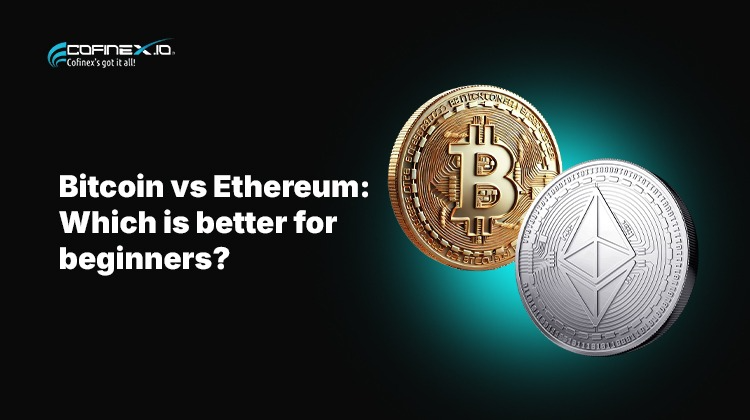
  • Bitcoin vs Ethereum: Which is better for beginners?

    Bitcoin vs Ethereum: Which is better for beginners?

    If you’re new to cryptocurrency, you’ve probably wondered where to begin. The two names you’ll hear most often are Bitcoin and Ethereum. Although both are leading cryptocurrencies, they were created for different purposes. In this guide, we’ll compare Bitcoin vs Ethereum, explain their key features, and help you decide which cryptocurrency may be the right choice for you.

    Bitcoin is best known as a digital store of value. Ethereum, however, is a blockchain platform that supports smart contracts and decentralized applications. By understanding their differences, beginners can make more informed investment decisions.

    Bitcoin vs Ethereum: What Is Bitcoin?

    Bitcoin (BTC) launched in 2009 as the world’s first cryptocurrency. Its creator designed it to let people send and receive digital payments without banks or other financial institutions.

    Today, many investors call Bitcoin “digital gold.” Its supply is limited to 21 million coins, which makes it one of the scarcest digital assets in the world. Because of this limited supply, many people see Bitcoin as a long-term investment.

    Key Features of Bitcoin

    • Maximum supply of 21 million coins.
    • Highly secure and decentralized network.
    • Accepted by many crypto platforms worldwide.
    • Popular for long-term investing.

    Bitcoin vs Ethereum: What Is Ethereum?

    Ethereum (ETH) entered the market in 2015. Unlike Bitcoin, Ethereum offers much more than digital payments. It gives developers a platform to build decentralized applications, often called dApps.

    In addition, Ethereum supports smart contracts. These digital agreements run automatically when specific conditions are met. As a result, Ethereum powers many DeFi platforms, NFT marketplaces, and Web3 projects.

    Ether (ETH) is the cryptocurrency that keeps the Ethereum network running. Users pay transaction fees with ETH whenever they interact with the blockchain.

    Key Features of Ethereum

    • Supports smart contracts.
    • Powers decentralized applications.
    • Large global developer community.
    • Regular upgrades improve the network.

    Bitcoin vs Ethereum: What’s the Difference?

    Although Bitcoin and Ethereum belong to the cryptocurrency market, they serve different purposes.

    Bitcoin focuses on storing and transferring value. In contrast, Ethereum focuses on powering blockchain applications and digital services.

    FeatureBitcoinEthereum
    Launch Year20092015
    Primary PurposeStore of valueSmart contracts and dApps
    Native CoinBTCETH
    Maximum Supply21 million BTCNo fixed maximum supply
    Main UseInvestment and paymentsBlockchain applications

    Bitcoin vs Ethereum: Which Is Better for Beginners?

    The answer depends on your financial goals.

    Choose Bitcoin if you:

    • Prefer a simple introduction to cryptocurrency.
    • Plan to invest for the long term.
    • Want exposure to the largest cryptocurrency.
    • Value a limited supply.

    Choose Ethereum if you:

    • Want to learn about blockchain technology.
    • Are interested in DeFi, NFTs, or Web3.
    • Want exposure to decentralized applications.
    • Enjoy exploring new blockchain innovations.

    Can Beginners Invest in Both?

    Yes. Many beginners decide to own both Bitcoin and Ethereum.

    Bitcoin gives investors exposure to the largest cryptocurrency by market capitalization. Meanwhile, Ethereum provides access to one of the most active blockchain ecosystems.

    Holding both assets can also improve diversification. As a result, investors gain exposure to different opportunities within the crypto market.

    What Should Beginners Consider?

    Before investing, think about a few important factors.

    • Your financial goals.
    • Your risk tolerance.
    • Your investment time horizon.
    • Current market volatility.
    • The importance of doing your own research.

    Most importantly, never invest more money than you can afford to lose.

    Final Thoughts

    The Bitcoin vs Ethereum debate does not have one correct answer. Instead, both cryptocurrencies offer different advantages.

    If you want a simple, well-known digital asset, Bitcoin may be the better choice. However, if you’re interested in blockchain technology and decentralized applications, Ethereum may suit your goals better.

    For many beginners, owning both cryptocurrencies offers a balanced approach. Overall, the best decision depends on your financial goals, investment strategy, and willingness to learn about the crypto market.

    Frequently Asked Questions

    Is Bitcoin safer than Ethereum?

    Both Bitcoin and Ethereum operate on well-established blockchain networks. However, every cryptocurrency carries investment risk, and prices can change quickly.

    Which cryptocurrency is easier for beginners?

    Many beginners find Bitcoin easier to understand because it has a simple purpose. Ethereum offers more features. However, it also requires a little more learning.

    Can I buy a fraction of Bitcoin or Ethereum?

    Yes. Most cryptocurrency exchanges allow you to buy small amounts of both Bitcoin and Ethereum.

    Should I invest only in Bitcoin or Ethereum?

    Not necessarily. Many investors hold both cryptocurrencies because each offers different benefits.

    Which cryptocurrency has more real-world use?

    Bitcoin mainly serves as a digital store of value and payment network. Meanwhile, Ethereum powers smart contracts, decentralized applications, and many Web3 services.

    Disclaimer: This article is for educational and informational purposes only. It should not be considered financial, legal, or investment advice. Cryptocurrency investments involve risk. Always conduct your own research before making financial decisions.