Artificial intelligence (AI) is changing how people interact with technology. At the same time, blockchain projects are exploring ways to bring AI services into decentralised ecosystems.
This combination has created a growing category in crypto: AI tokens.
Some projects use tokens to pay for computing resources, access AI services, reward contributors, or participate in decentralised networks. Others attract attention mainly because they include AI in their marketing.
However, not every project connected to artificial intelligence offers meaningful value.
So, how can investors distinguish real utility from hype? Let’s understand.
What are AI Tokens?
AI tokens are cryptocurrencies associated with blockchain projects that focus on artificial intelligence or AI-related services.
These tokens may support different activities within an ecosystem, depending on how the project operates.
For example, an AI-focused blockchain project might use its token to:
- Pay for AI services or computing resources.
- Reward users who contribute data or processing power.
- Access decentralised AI applications.
- Participate in network governance.
- Support transactions within an AI-powered ecosystem.
However, not every AI token performs all these functions. Each project has its own token design and purpose.
It is also important to understand that an AI token does not automatically mean the project has developed its own artificial intelligence technology.
Where can AI Tokens offer real Utility?
AI and blockchain can work together in several areas. The actual usefulness depends on whether the project solves a genuine problem.
1. Decentralised Computing
AI models require significant computing resources. Some blockchain projects aim to create decentralised networks where people can contribute computing power.
A token may reward participants who provide these resources.
If the network attracts genuine users and developers, the token could have a practical role in supporting its ecosystem.
2. AI Model and Service Access
Some projects aim to provide access to AI tools, models, or services through blockchain-based platforms.
Users may need tokens to pay for certain services or access specific features.
In this case, utility depends on whether people actually use the platform and whether the token plays a necessary role in accessing its services.
3. Data Contribution and Marketplaces
AI systems need data for training, testing, and improving models.
Some decentralised projects aim to create marketplaces where contributors provide data or related services and receive rewards.
A token may facilitate payments or incentives within such a marketplace.
However, projects must also address data quality, privacy, ownership, and consent.
4. Decentralised AI Applications
Developers are exploring blockchain-based applications that combine AI capabilities with decentralised infrastructure.
These applications may use tokens for payments, access, rewards, or governance.
Their long-term value depends on whether they attract real users and provide services that people find useful.
When does AI become marketing hype?
The word “AI” can attract attention, but a strong narrative does not necessarily indicate a strong project.
Some warning signs deserve attention before considering an AI token.
1. No Clear Product or Working Technology
A project may make ambitious promises without demonstrating a working product.
If its website focuses heavily on future plans but provides little evidence of actual development, investors should be cautious.
2. Unclear Token Utility
A project may have an AI platform, but that does not automatically mean its cryptocurrency is necessary.
Ask a simple question: What specific function does the token perform?
If the project cannot explain why it needs a token, its practical value may be difficult to assess.
3. Marketing Without Real Users
Social media activity, influencer promotions, and online discussions can create the impression of strong demand.
However, attention is different from adoption.
Look for evidence of active users, developers, transactions, paying customers, or other meaningful network activity.
4. Unrealistic Promises
Be cautious when a project promises guaranteed returns, rapid growth, or revolutionary AI capabilities without verifiable evidence.
Technology development takes time, and no crypto project can guarantee investment profits.
5. Limited Transparency
Investors should be able to understand who is developing the project, how its technology works, and how its token operates.
Unclear documentation, unexplained token allocations, and missing development updates can make it difficult to evaluate a project.
How to Evaluate an AI Token Before Investing
Instead of investing because a token is trending, examine the project from a practical perspective.
Here are five questions worth asking:
1. What problem does the project solve?
Understand the problem before looking at the token price. Does the project address a genuine need in AI, computing, data, or decentralised applications?
2. Is there a working product?
Check whether the project has a usable platform, working application, developer documentation, or demonstrable technology.
3. Does the token have a real purpose?
Find out whether the token supports payments, network participation, rewards, or governance. Also consider whether users actually need it.
4. Is there evidence of adoption?
Look beyond social media followers. Review platform activity, partnerships, developer participation, customer usage, and other verifiable indicators.
5. Is the token economy sustainable?
Understand the circulating supply, total supply, token distribution, unlock schedules, and potential selling pressure.
A project may have a useful product but still face token-related risks.
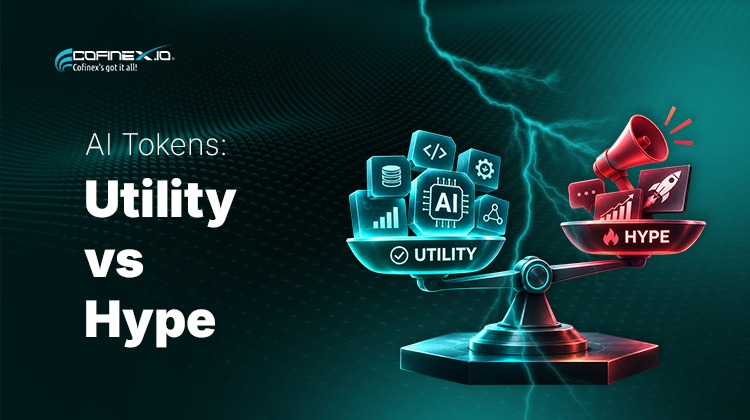
AI Token Utility vs Hype: Understanding the Difference
| Real Utility | Market Hype |
|---|---|
| Solves a clearly defined problem | Relies on broad AI-related claims |
| Demonstrates working technology | Focuses mainly on future promises |
| Has a clear token purpose | Has unclear token utility |
| Shows measurable user activity | Depends heavily on social media attention |
| Provides transparent documentation | Offers limited project information |
| Builds long-term development plans | Focuses mainly on short-term excitement |
This comparison does not guarantee that a project with real utility will succeed. Even useful technology can face competition, technical challenges, and market risks.
Does Real Utility Guarantee Token Price Growth?
No.
A project can develop useful technology and attract users without its token price increasing.
Token prices also depend on market demand, supply, liquidity, investor sentiment, competition, regulations, and broader market conditions.
In some cases, the platform may succeed while the token struggles to capture that value.
Therefore, investors should evaluate the technology and the token separately.
Final Thoughts
AI and blockchain create interesting opportunities for innovation. However, the presence of AI in a project’s branding does not automatically make its token valuable.
Before evaluating an AI token, look beyond the narrative. Understand the product, examine its actual use cases, check token utility, and review the project’s transparency.
In crypto, a strong story can attract attention. Real utility gives people a reason to use a product.
Do your research, question unrealistic promises, and never confuse market hype with long-term potential.